

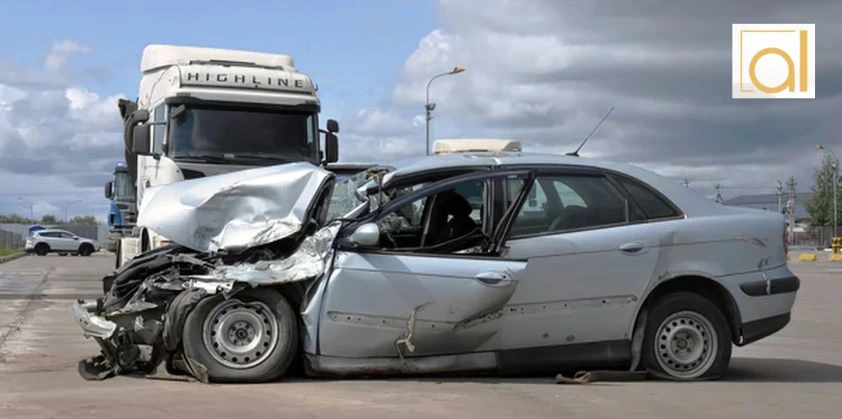

One second you’re driving past a tractor-trailer, nothing unusual about it. The next, its trailer has drifted into your lane and you’re bracing against the guardrail before you even understand what’s happening.
That’s the physics of a no-zone. Federal regulators built an entire safety campaign around the blind spots on commercial trucks because so many people get hurt in them without doing anything wrong. A truck blind-spot accident attorney’s first job is proving exactly that: you were where you had every right to be, and the truck simply couldn’t see you.
At Ainsman Levine, LLC, our Pittsburgh injury lawyers have spent decades untangling who’s at fault when a tractor-trailer’s blind spot turns into someone’s emergency room visit.
What a Truck’s No-Zone Actually Means
A no-zone is federal shorthand for the space around a tractor-trailer where the driver has no way to see you, mirrors included. The Federal Motor Carrier Safety Administration (FMCSA) built its “Our Roads, Our Safety” campaign around these zones for a reason.
Passenger cars have rearview mirrors and a driver who can turn and look. Truck drivers sit high above traffic with no rear window at all, relying entirely on convex mirrors that still leave enormous gaps. Stay in one of those gaps too long and you effectively disappear.
The Four No-Zones Around Every Tractor-Trailer
Commercial trucks carry blind spots on every side, and each one behaves differently along Pittsburgh’s parkways and interstates.
- Front: extends roughly 20 feet ahead of the cab, hidden by the driver’s elevated seating position.
- Rear: stretches 30 feet or more behind the trailer, sometimes past 200 feet, since there’s no rear mirror at all.
- Right side: the largest and most dangerous zone, spanning nearly two lanes back past the length of the trailer.
- Left side: narrower than the right, but still wide enough to hide a sedan through a lane change.
Why a Truck’s Right Turn Can Trap You?
Right turns are where the right side no-zone turns lethal. A tractor-trailer needs a turning radius of about 55 feet, so the cab often swings left before cutting back right, and the trailer tracks a tighter path than the cab did. A driver or cyclist sitting beside the truck, thinking they have room, gets caught in that inside path with nowhere to go.
Downtown Pittsburgh’s tight one-way grid makes this worse, since drivers instinctively pull alongside a stopped truck without realizing where its trailer is about to swing.
Why Stopping Distance Matters as Much as Sight Lines?
A loaded semi can weigh up to 40 tons and needs nearly twice the stopping distance of a passenger car. At highway speed, that can mean up to two football fields of pavement.
That’s why cutting in front of a truck along the Parkway East corridor, even briefly, is its own kind of no-zone problem: you’ve just put yourself in the front blind spot, and the truck behind you doesn’t have anywhere near the stopping power to react if you slow down or brake.
Who Can Be Held Liable for a Blind Spot Crash?
A no-zone collision rarely starts and ends with the driver behind the wheel. Because commercial trucking runs through layers of contracts and inspections, more than one party can share the blame.
The Driver
Fatigue, distraction, or simply an inadequate check of the mirrors before a lane change or turn all point back to the person driving.
The Trucking Company
Unrealistic schedules, thin training, or skipping required blind spot monitoring equipment can make the carrier responsible alongside its driver.
Everyone Else in the Chain
A maintenance shop that missed a mirror defect, a shipper whose unsecured cargo caused a jackknife, or a parts manufacturer can all end up named in a serious case.
We Fight — So You Don’t Have To
Decades of courtroom experience. Thousands of clients helped.
When the Insurer Blames You for Being in the Blind Spot?
Insurance adjusters know the no-zone concept too, and they’ll use it against you. The standard move is arguing you lingered in the truck’s blind spot, whether you were riding beside it too long or following closer than you should have, and shifting enough blame your way to cut what they owe.
Under Pennsylvania’s comparative negligence rule, 42 Pa.C.S. § 7102, that argument doesn’t have to end your claim. But it has to be answered with real evidence: the truck’s electronic logging device data showing its speed and lane position, dash cam or nearby traffic camera footage, and the driver’s own mirror angles at the time of impact.
Attorney Daniel Sammel spent years on the other side of this exact playbook, defending trucking companies before switching to represent injured drivers, and knows which of those records adjusters hope you never think to request.
Reach Out We’ll Handle the Rest
Let’s discuss your situation and plan your next steps.
FAQs
Can I still recover damages if I was in the truck’s blind spot when it hit me?
Yes, being in the no-zone doesn’t automatically make you at fault. You’ll still recover as long as you’re found 50% or less responsible, with your award reduced by whatever share is yours. Worth pinning that number down before you accept any settlement offer.
What if the trucking company says its driver checked all his mirrors?
That’s their standard opening move, and it doesn’t end the conversation. FMCSA’s own crash data ties inadequate surveillance to about 14% of large truck crashes, meaning drivers often look and still miss what’s right there. Black box and dash cam data usually settle the question fast.
How much is a Pittsburgh truck blind spot accident case worth?
It depends on your injuries, lost income, and who else was involved, so there’s no flat number to quote. A free case review gets you a real range instead of a guess. Past results do not guarantee a similar outcome.
How long do I have to file a truck accident claim in Pennsylvania?
You generally have two years from the crash date under 42 Pa.C.S. § 5524. Miss that window and you’ll likely lose the right to sue no matter how strong the case looked. Evidence like ELD data gets purged well before then, so earlier is always better.
Should I talk to the trucking company’s insurance adjuster before calling a lawyer?
It’s better to hold off on a recorded statement until someone is in your corner. Adjusters are trained to ask questions that nudge your share of fault upward, which cuts directly into what you’re owed. A quick call first costs you nothing and protects what you say later.
Ainsman Levine, LLC: Your Pittsburgh Truck Accident Law Firm
No-zone crashes leave you with damage nobody can explain and an insurance file already stacked against you. That’s the moment to stop guessing and get someone pulling the black box data, the driver’s logs, and the mirror angles before a repair shop erases the evidence.
At Ainsman Levine, LLC, we’ve spent more than three decades pulling apart exactly these questions for Western Pennsylvania families, and we work on contingency, so nothing is owed unless we recover for you. Contact our firm today, and let’s find out what happened out there, and what it’s worth.


 ES
ES